askPulse for breeders: worked examples
askPulse answers gene questions across pulses, where most crops have several assemblies and few have their own QTL data: which gene does a paper's ID mean today, which genes sit under a mapped locus, which soybean or Medicago result carries over to pea, chickpea, lentil or lupin, and where a sequence lands. It joins Ensembl Plants genomes (pea, faba bean, narrow-leafed lupin, soybean, common bean, Medicago and others), Legume Information System (LIS) chickpea and lentil genes, pangenes, gene families, QTL and GWAS, the lupin 97L380 map, expression atlases and genebank records, and links every answer to its source.
| Breeding question | Where to start | Example |
|---|---|---|
| Which gene does a paper's chickpea ID mean now, and where is it expressed? | Gene page, AI assistant | 1. Chickpea Ca_00003 |
| Which genes sit under a mapped domestication locus? | Trait map, JBrowse on Tanjil | 2. Lupin Iucundus |
| Which gene underlies a GWAS hit in a model legume? | JBrowse with QTL track, AI assistant | 3. Soybean seed oil |
| What is the pea, lentil or lupin version of a soybean gene? | AI assistant (orthologues, families, BLAST) | 4. SWEET39 across legumes |
| Which genes in my crop have a given function? | Gene finder | 5. NLRs in pea |
| Which genes respond to frost, and do tolerant and susceptible lines differ? | AI assistant (expression tools) | 6. Faba bean cold response |
How to use these examples
The web pages need no account. The MCP server (https://askpulse.plantdatabases.org/mcp) plugs askPulse into an AI assistant such as Claude as a custom connector; ai.html shows how to connect and lists every tool. Each example has a Try it box with a prompt, the tools the assistant calls, real askPulse output (November 2026) and what to take from it.
- Name the crop and, for chickpea, the genotype: kabuli and desi Ca_ IDs with the same number are different genes.
- Chickpea and lentil genes come from LIS, not Ensembl; the assistant picks the right tools when you name the crop.
- QTL and GWAS: LIS covers soybean, common bean, cowpea and peanut; faba bean (QTL compilation), lentil (seed protein GWAS) and pulsedb.org records add pea, chickpea, lentil and faba bean. Otherwise translate from the model legumes (example 4).
1. Which gene does a paper mean? (chickpea IDs and expression)
Chickpea papers use at least three gene sets: the original kabuli Ca_ IDs (CDC Frontier v1/v2), the desi ICC 4958 Ca_ IDs and the current kabuli CDC Frontier v3 (Ca1g000200 style), which is the one with expression data. LIS pangenes link them.
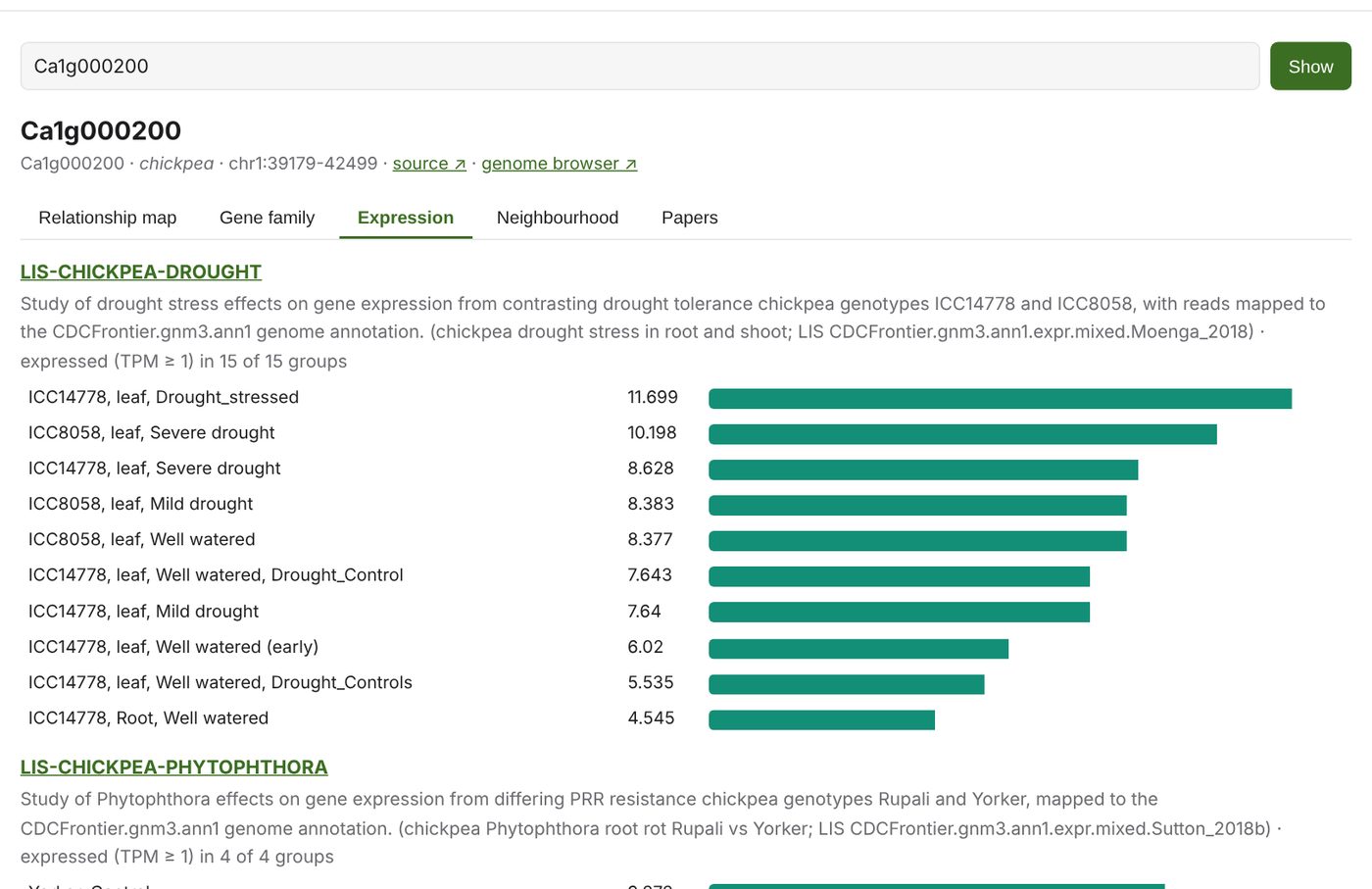 Gene page for Ca1g000200, Expression tab: TPM by genotype and treatment in the LIS chickpea drought study.
Try it
A paper mentions the kabuli chickpea gene Ca_00003. What is it in CDC Frontier v3 and in wild Cicer, where is it expressed, and what are its relatives in pea and Medicago?
Tools called: legume_pangene (dataset chickpea_kabuli_v1), gene_expression, legume_family.
| Assembly | Gene | Location |
|---|---|---|
| Kabuli CDC Frontier v1 (Ca_ IDs, UWA v2.6.3 assembly) | Ca_00003 | Ca1:29,243–29,599 |
| Kabuli CDC Frontier v2 | Ca_00003 | |
| Kabuli CDC Frontier v3 | Ca1g000200 | chr1:39,179–42,499 |
| C. reticulatum Besev079 (wild) | Cr1g000200 |
Expression of Ca1g000200 across the LIS chickpea studies (highest group per study): drought 11.7 TPM (ICC14778 leaf, drought-stressed), Phytophthora 9.4 (Yorker control), development 8.7 (flower), nitrogen 7.7 (leaf, inorganic N), salt 6.1 (Rupali, 60 mM NaCl). Gene family Legume.fam3.16708: 2 kabuli v3 members, 2 desi, 2 Medicago, 1 pea.
What to take from it. Always convert a paper's ID before looking up expression or position, and say which genotype it came from; askPulse asks when a Ca_ number exists in both kabuli and desi. A family is broader than an orthologue group, so "in the same family" is the claim to make.
2. From a domestication locus to candidate genes (lupin Iucundus)
The narrow-leafed lupin 97L380 map (Hane et al. 2017, doi:10.1111/pbi.12615) places the domestication loci (Tardus and Lentus pod shattering, Leucospermus, Iucundus low alkaloid, Mollis, Ku, Lanr1) among 9,972 markers anchored to the Tanjil genome. askPulse estimates each locus's physical interval from its anchored neighbours, draws the loci on the trait map and shows them in JBrowse.
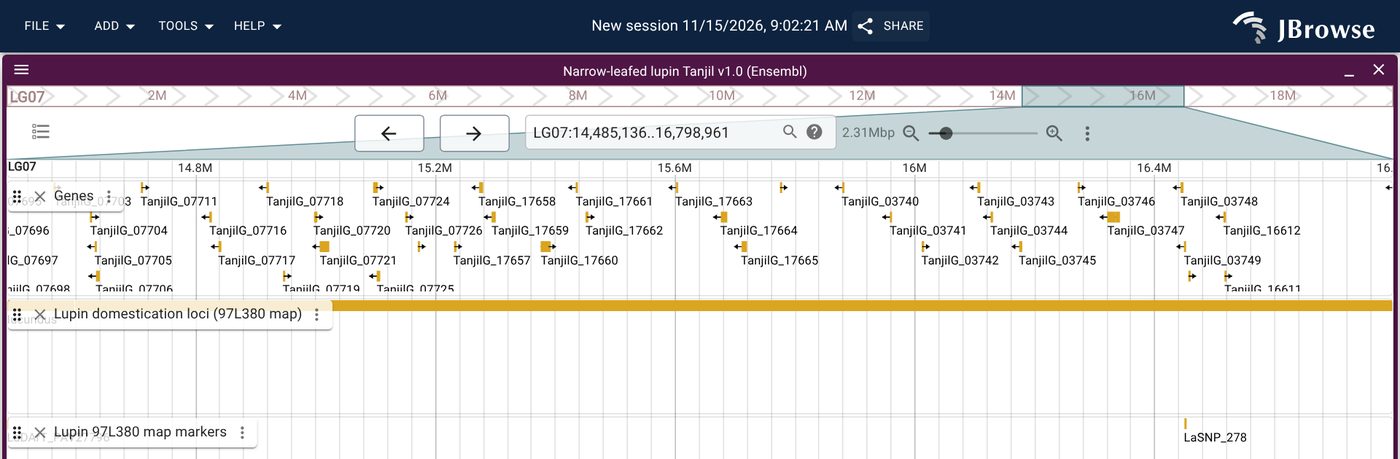 The estimated Iucundus interval on Tanjil LG07 (14.5–16.8 Mb) with genes and 97L380 map markers.
Try it
Where is the lupin low-alkaloid locus Iucundus, which genes are in its interval, and are any transcription factors of the AP2/ERF family? Is there a published marker?
Tools called: lupin_markers (trait "alkaloid"), genes_in_region, genes_with_annotation (term "AP2/ERF", region), search_literature.
| Item | Result |
|---|---|
| Map position | LG07, 79.3 cM (framework locus) |
| Flanking anchored markers | LaDArT_PAV27796 (LG07:14,484,831) to LaSNP_475 (LG07:16,798,656) |
| Estimated interval | LG07:14,484,831–16,798,656 (2.31 Mb) |
| Genes in the interval | 49 |
| AP2/ERF genes in the interval | 1: TanjilG_03746 (LG07:16,270,825–16,271,337) |
| Literature | Kroc et al. 2019, a gene-targeted dCAPS marker for low alkaloid (doi:10.3390/genes10060428) |
What to take from it. A mapped locus becomes a list of 49 genes, and a function filter narrows it to one transcription factor of the family proposed for low alkaloid content. Check the gene ID used in the marker paper against TanjilG_03746 before relying on it. The interval is estimated from map neighbours: genes near its edges may lie outside the true locus.
3. From a GWAS hit to a gene (soybean seed oil)
LIS QTL and GWAS for soybean, common bean, cowpea and peanut are searchable by trait and region, and soybean and common bean results are drawn in JBrowse on the Ensembl assemblies.
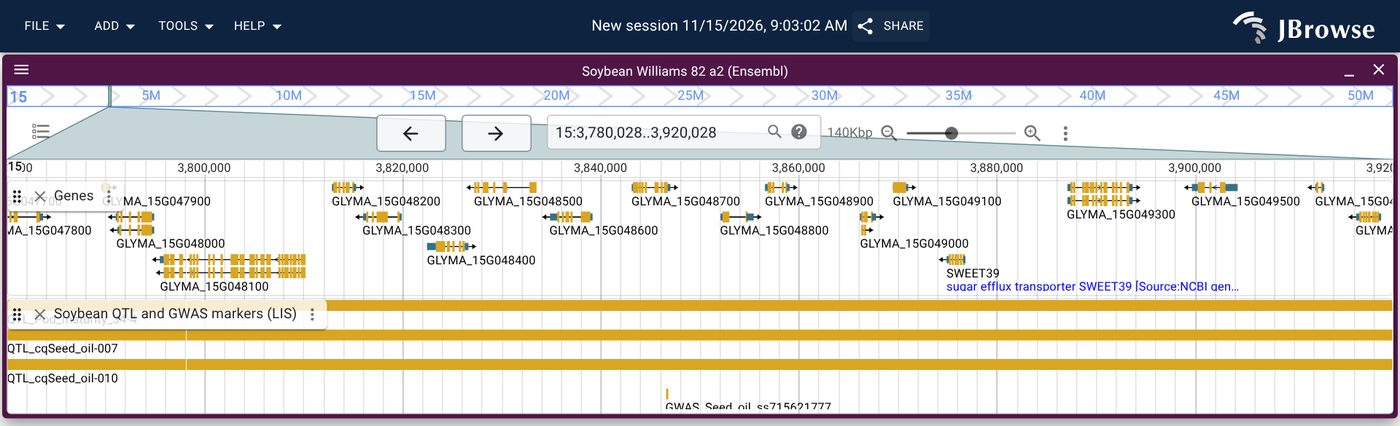 Soybean Wm82 a2 chromosome 15: genes, LIS seed-oil QTL and GWAS markers; SWEET39 (GLYMA_15G049200) lies under the peak.
Try it
Step 1, find the hit:
What are the strongest soybean GWAS associations for seed oil? Give the marker, position on Wm82.a2 and the genes within 100 kb.
Tools called: legume_qtl (trait "seed oil", species soybean), genes_in_region.
Seed oil has 18 GWAS associations in LIS. The strongest, ss715621777 (p = 1.5 × 10⁻²⁷), sits at Gm15:3,846,538 on Wm82.a2 (Ensembl chromosome 15). The 200 kb around it holds 28 genes, among them GLYMA_15G049200, SWEET39, a sugar efflux transporter.
Step 2, check the literature:
Find papers on GLYMA_15G049200.
gene_papers finds no paper citing GLYMA_15G049200 and 2 naming SWEET39 in the title or abstract. Asking again with the LIS-style ID and the gene name, "Search full text for Glyma.15G049200 or GmSWEET39" (search_literature), gives 82 papers, including Miao et al. 2020, Selection of GmSWEET39 for oil and protein improvement in soybean (doi:10.1371/journal.pgen.1009114).
What to take from it. The GWAS peak points to a gene already shown to control seed oil and protein. Papers write soybean IDs as Glyma.15G049200, not the Ensembl GLYMA_15G049200, so search both forms and the gene name. QTL from older studies often have only RFLP or SSR markers without positions; ask for "QTL with physical positions" to skip them.
4. Translating a gene across legumes (SWEET39 to pea, lentil and lupin)
A result in soybean or Medicago is only useful to a pea, chickpea, lentil or lupin breeder once it is translated. askPulse has three ways to do it, which answer slightly different questions.
Try it
Find the pea, faba bean, lupin, common bean, chickpea and lentil counterparts of soybean SWEET39 (GLYMA_15G049200), using Compara orthologues, the LIS gene family and BLAST, and compare the answers.
Tools called: orthologues, legume_family, blast_sequence (the 249 aa protein against all protein sets).
| Crop | Compara orthologue | LIS family members (first) | Best BLAST hit (identity) |
|---|---|---|---|
| Pea | none | Psat0s1880g0080, Psat0s3611g0040, Psat1g219320 | Psat0s3611g0040 (60.7%) |
| Faba bean | none | not in LIS families | Vfaba.Hedin2.R1.1g001040 (60.5%) |
| Narrow-leafed lupin | TanjilG_09146, TanjilG_09147, TanjilG_17544 (many-to-many) | not in LIS families | TanjilG_09146 (60.1%) |
| Common bean | PHAVU_006G210800g (one-to-many, 59.7%) | not in LIS families | PHAVU_006G210800g (67.4%) |
| Chickpea | not in Compara | Ca1g010100, Ca2g164400, Ca3g389900 (v3) | Ca2g164400 (59.4%) |
| Lentil | not in Compara | Lcu.2RBY.2g001170, Lcu.2RBY.6g001340, Lcu.2RBY.6g001350 | Lcu.2RBY.2g001170 (53.2%) |
The second soybean copy, GLYMA_08G183500, is 91.8% identical; the wild soybean orthologue is one-to-one (90.7%).
What to take from it. Where they overlap, the three methods agree (TanjilG_09146, PHAVU_006G210800g, Ca2g164400, Lcu.2RBY.2g001170). Compara gives the relationship type but misses genomes outside it (chickpea, lentil) and sometimes pea; LIS families reach chickpea and lentil but are broad (8 soybean members); BLAST works for every genome, gives only similarity, and is the check when the other two disagree. Around 60% identity with several family members, treat the counterparts as candidates and check gene-family trees before naming one.
5. Genes by function in a pulse genome (NLRs in pea)
The gene finder works for pea, faba bean, lupin, soybean, common bean and Medicago, with each gene's position, matched terms and a genome-browser link. Add a chromosome and interval to restrict it to a QTL, or choose Pathway for a Plant Reactome pathway.
Try it
How many NB-ARC genes does pea have, and on which chromosomes? Bar chart by chromosome.
Tool called: genes_with_annotation (term "NB-ARC", species pisum_sativum).
118 pea genes, with the facet counts per chromosome that the assistant charts:
| Chromosome (Cameor v1a) | 1LG6 | 2LG1 | 3LG5 | 4LG4 | 5LG3 | 6LG2 | 7LG7 | unplaced scaffolds |
|---|---|---|---|---|---|---|---|---|
| NB-ARC genes | 5 | 18 | 9 | 10 | 43 | 10 | 9 | 14 |
What to take from it. Over a third of pea NLRs are on chromosome 5 (linkage group III), so a resistance QTL there will have many domain candidates. Pea chromosomes are named with their linkage group (5LG3); use that name in a region query. Domain annotation is electronic: it shortlists, it does not prove resistance. For pea, faba bean and lentil, whose QTL are not in LIS, take an interval from the paper in the matching assembly and bring it here.
6. Frost response in faba bean (winter vs spring type)
askPulse quantified faba bean RNA-seq itself (Ensembl Hedin/2 v1 genes): leaves of the frost-tolerant winter cultivar Wonjam1-ho and the susceptible accession PI 271634 at 18, 4, 0 and −7 °C (Zhang et al. 2026), developing seeds of Hedin/2 and Tiffany, and an Iso-Seq tissue atlas.
Try it
Which faba bean genes are most strongly induced at −7 °C in Wonjam1-ho? For the top proline-biosynthesis gene, compare both genotypes and give its Arabidopsis orthologue.
Tools called: expression_genes, gene_expression, arabidopsis_function.
2,068 genes are significantly up at −7 °C in Wonjam1-ho. One of the strongest, Vfaba.Hedin2.R1.Ung024080, is orthologous to Arabidopsis P5CS1 / P5CS2 (AT2G39800, AT3G55610; proline biosynthesis):
| Genotype | 18 °C (TPM) | 4 °C | 0 °C | −7 °C | log2FC at −7 °C |
|---|---|---|---|---|---|
| Wonjam1-ho (tolerant) | 0.1 | 119 | 88 | 105 | +9.7 |
| PI 271634 (susceptible) | 1.8 | 390 | 283 | 314 | +7.8 |
What to take from it. Both genotypes switch the P5CS copy on strongly. The larger fold change in Wonjam1-ho comes from its lower 18 °C level, not higher cold expression, so this gene does not by itself explain the tolerance difference. To find genotype differences, ask for genes up in one genotype only. The gene sits on an unplaced scaffold (Ung) of Hedin/2 v1; legume_gene gives its Hedin/2 v2 match where there is one. Arabidopsis function is inferred by orthology.
Prompts for an AI assistant, with visualisations
| Goal | Prompt | Picture you get |
|---|---|---|
| Domestication loci | Show the lupin domestication loci on the Tanjil chromosomes and list genes in each interval. | Chromosome diagram |
| Expression | Plot TPM of chickpea Ca1g000200 across all LIS chickpea studies. | Grouped bar chart |
| QTL map | Plot soybean seed oil and protein QTL with physical positions on the chromosomes. | Chromosome plot |
| Translation | For these 10 soybean genes, give the pea and lentil counterparts by Compara, LIS family and BLAST. | Comparison table |
| Pangenes | Convert these desi Ca_ IDs to CDC Frontier v3 and give their positions. | Table |
| Synteny | Show the neighbourhood of PHAVU_006G210800g in soybean, pea and Medicago. | Synteny diagram |
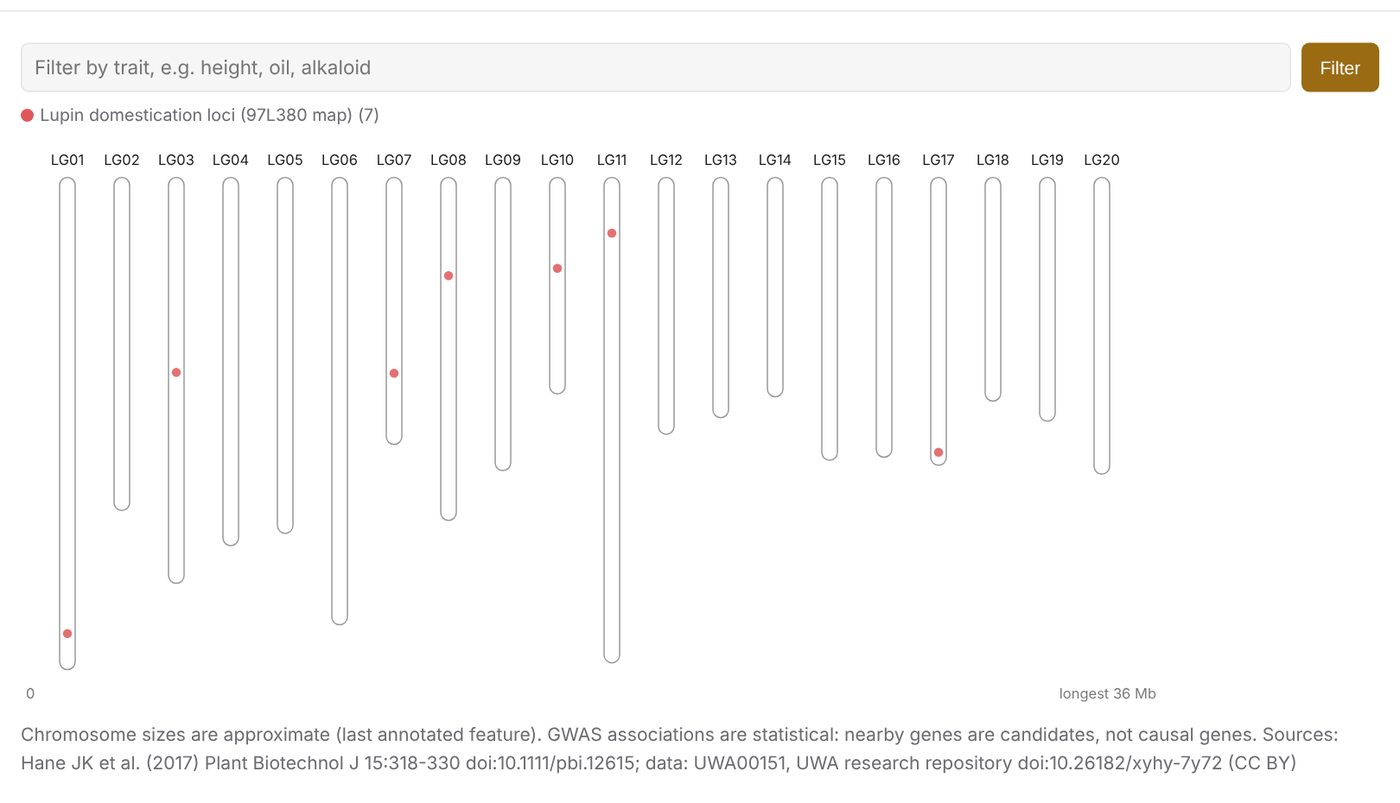 Trait map: narrow-leafed lupin domestication loci on the Tanjil linkage groups.
Before acting on a result
- Chickpea has three gene sets on three assemblies; kabuli and desi Ca_ IDs with the same number are different genes.
- LIS gene families are broader than orthologue groups; Compara does not include chickpea or lentil.
- Lupin locus intervals are estimated from neighbouring anchored markers; genes there are candidates.
- Soybean IDs appear as GLYMA_15G049200 (Ensembl) and Glyma.15G049200 (LIS, papers); search both.
- GWAS and QTL markers near a gene make it a candidate, not the cause.
Results shown were produced with askCrop tools in November 2026; numbers change as source databases update.